Introduction
The Bonya Rare Earth Project comprises two separate carbonatite sheeted complexes located on two exploration licences, a few kilometres apart in southern Namibia.



Introduction
The Bonya Rare Earth Project comprises two separate carbonatite sheeted complexes located on two exploration licences, a few kilometres apart in southern Namibia.
For more details on the Bonya Rare Earths Project please see Bonya Rare Earths Project Review March 2026.pdf

LOCATION MAP
The Teufelskuppe and Keishohe carbonatites have been subject to exploration over a number of years. The resulting exploration data provides the material required to rapidly advance the Project through targeted resource drilling, metallurgical test work and preliminary development planning and scheduling. Kendrick’s development programme aims to add significant shareholder value through a focused tried and tested development regime that will allow investors and the Market to make an informed decision on the real value of this Kendrick asset.
The Project is located approximately 60km inland of the Lüderitz port and deepwater terminal and 50km from the settlement of Aus. A major tarred road that extends to Lüderitz and serves the delivery of South African manganese for export runs 10km from the Keishohe licence. Parallel to the road and only a few hundred metres away, a rail line also runs through to the coast. A national grid powerline bisects the licences and runs between Lüderitz and a lead zinc mine to the south.

IMPRESSIVE INFRASTRUCTURE WITH TARRED ROAD, RAIL AND POWERLINES RUNNING IN PARALLEL
Teufelskuppe REE Carbonatite
Teufelskuppe or “TK” is distinguished by exceptional rare earth grades averaging 3.12% TREO (“Total Rare Earth Oxides”). This includes a high-grade notional “starter pit” running at an average grade of 4.54% TREO at a 3% cut-off.

THE NATIONAL GRID POWER LINE BISSECTS THE TEUFELSKUPPE EXPLORATION LICENCE
Radioactive elements and specifically Thorium occur at low levels and are not expected to impact on concentrate quality.
Teufelskuppe is characterised by high grades for light REOs, namely Neodymium and Praseodymium and Samarium.

FLOW BANDING EVIDENT IN TEUFELSKUPPE CARBONATITE
The Teufelskuppe Carbonatite Complex forms a circular group of hills with a diameter of 1km. Eight outcropping areas of the complex have been designated TK1A, TK1B, and TK2 to TK7. The complex consists of a central high grade core of plugs (represented by outcrops TK1A and TK1B) and dykes (outcrop TK2), which is surrounded by a lower grade peripheral cone sheet system (outcrop areas TK3 to TK7).
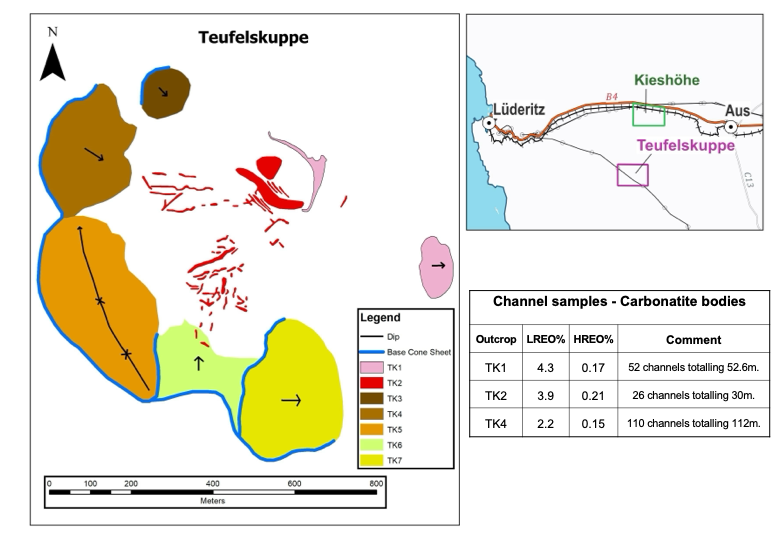
The sub-vertical plugs, and steep to moderately dipping dykes form a randomly oriented stockwork at the core of the complex. The shallow dipping peripheral cone sheets dip inwards towards the centre of the complex.
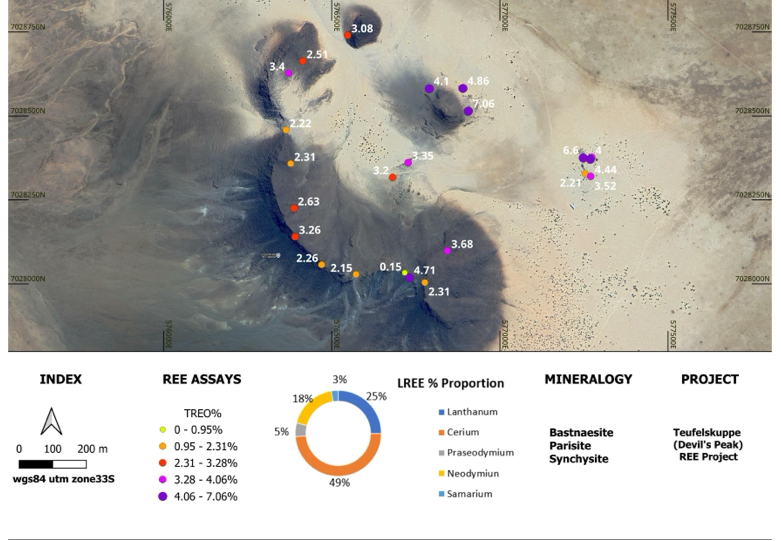
TUEFELSKUPPE MOST RECENT SAMPLING REGIME REPORTING IMPRESSIVE HIGH GRADES FOR TREOs
The association of the shallow dipping peripheral cone sheets surrounding the central zone of the complex, implies the cone sheets were emplaced within a ring structure, which developed in response to the emplacement of the central zone plugs. The dykes of the central stock-work post-date the peripheral cone sheet system.

TYPICAL TEUFELSKUPPE HIGH-GRADE MINERALISED OUTCROP TK2
Teufelskuppe channel and rock chip samples were analysed by ICP-AES by ALS in Vancouver. High REE concentrations (Ce >10,000 ppm; La >10,000 ppm, Nd >10,000 ppm; Pr >1,000 ppm, and Sm >1,000 ppm), were re-analysed.
Samples from the central zone TK1A & TK1B plugs and the TK2 central zone dykes report the highest REO (4.47 & 4.18% REO, respectively).

HIGH-GRADE TEUFELSKUPPE OUTCROP TK1
High-Grade Rare Earth Elements (REEs): The deposit contains a high concentration of REEs, essential materials for modern technology.
Average Total Rare Earth Oxide (TREO) Content: 3.12%, indicating a significant amount of REEs in the deposit.
High-Grade Samples: 50% of samples have TREO concentrations over 2.8%, with an average of 3.4% for high-grade samples.
Valuable REEs: Neodymium and praseodymium, the key elements for various technologies fundamental to national security and economic resilience, are present in significant amounts.
Neodymium (Nd) and Praseodymium (Pr): The average concentration of neodymium and praseodymium oxides across all samples is 0.70 Wt %.
Nd2O3 to TREO Ratio: The ratio of Nd2O3 to TREO is 17.63. This ratio provides insights into the relative abundance of neodymium within the total REE content.
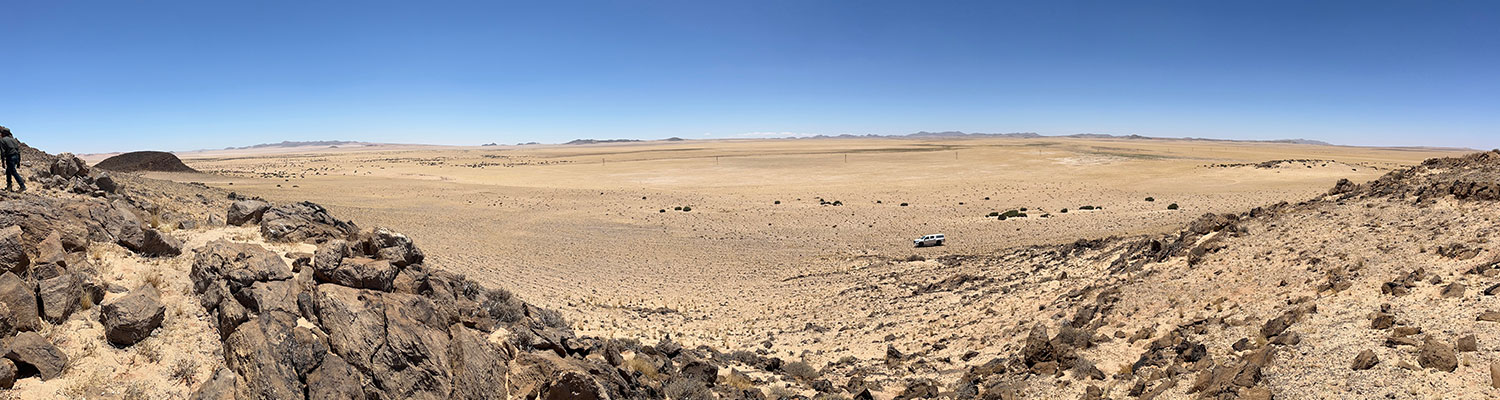
Prominent outcrops stand up to 120m above the surrounding plain.
Whilst a JORC (2012) Resource estimate remains to be completed, an historic in-house tonnage estimate of approximately 4Mt of mineralised carbonates are reported to be exposed above ground. No estimate has been undertaken to include sub-surface fluorocarbonate mineralisation or the potential bulk tonnage associated with breccia located between the fluorocarbonate sheets.
The well exposed flow banding emplacement structures, the substantial gravity anomaly associated with the high-grade (4.47% REO) TK1A outcrop, together with the perceived structural level of the exposed part of the carbonatite (which is interpreted to be the cap of a diatreme), provide confirmation that mineralisation extends to depth. In contrast to weathered and supergene enriched carbonate systems the late-magmatic mineralization at Teufelskuppe is not expected to decrease in grade at depth.
Keishohe REE Carbonatite
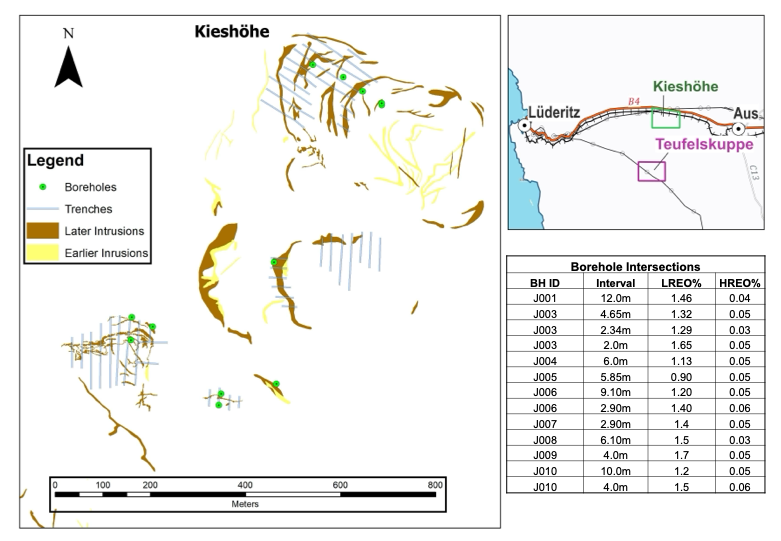
KEISHOHE MINERALISED SHERTS, CONES AND DYKES IN CARBONATITE RING COMPLEX
Keishohe represents another potentially substantial carbonatite complex with multiple mineralised structures comprising sheets, cones, dykes and sills identified within a 1km by 1.5km complex.
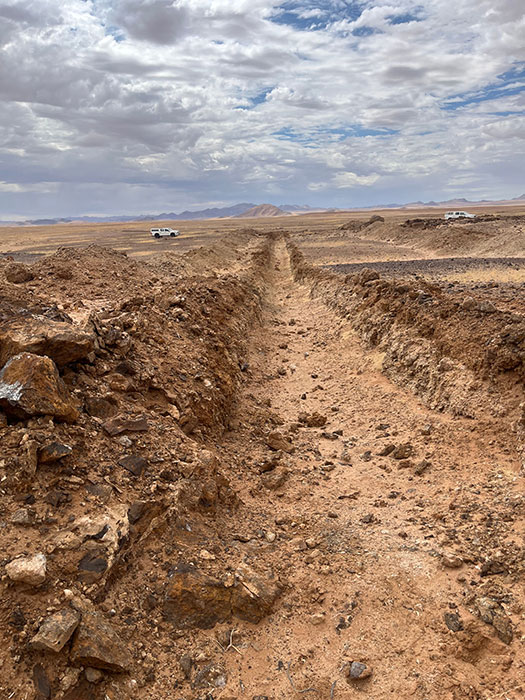
KEISHOHE TRENCHING
Located 30km NNE of Teufelskuppe, the Keishohe complex offers an average TREO grade of 1.54%. Lower than Teufelskuppe but still significantly higher than many REE projects worldwide and estimated to potentially be in the upper quartile in terms of grade with further evaluation.
14 diamond holes drilled for a total of 1,452m have to date been completed at Keishohe leading previous operators to identify 3 open pit targets warranting further evaluation.

KEISHOHE BOREHOLE COLLAR
The proposed pits were further evaluated by extensive close-spaced trenching over many kilometres.
The historic exploration has broadly defined a ‘geological resource’ that Kendrick can evaluate more fully to determine a recognisable Mineral Resource.